

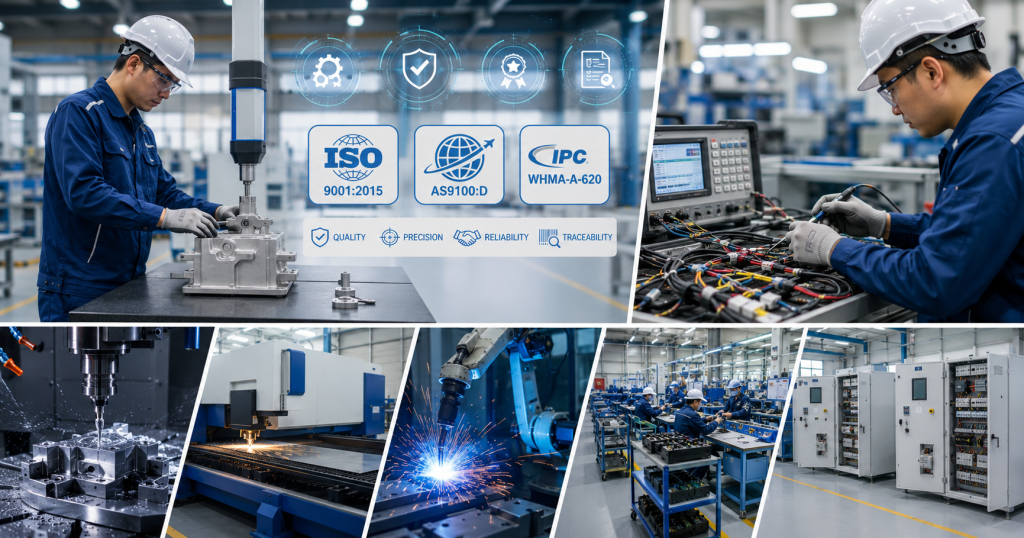
In precision manufacturing, quality cannot be treated as a final inspection step.
For industries such as aerospace, semiconductor, automotive, medical technology, and industrial automation, quality must be built into every stage of production—from material sourcing and engineering review to machining, fabrication, assembly, testing, and final delivery.
This is why manufacturing certifications matter.
For customers evaluating a contract manufacturer in Malaysia, certifications such as ISO 9001:2015, AS9100:D, and IPC/WHMA-A-620 provide an important indication of how seriously a manufacturer approaches quality management, process control, traceability, and continuous improvement.
Smartlink Engineering Sdn Bhd has developed its manufacturing operations around these principles. The company identifies ISO 9001:2015 and AS9100:D among its quality certifications, while its cable harnessing operations follow the rigorous workmanship requirements of IPC/WHMA-A-620. (Smartlink Engineering)
But what do these standards actually mean for customers?
More importantly, how do they translate into better manufacturing outcomes?
Why Certifications Matter in Contract Manufacturing
When an OEM outsources production, it is also outsourcing part of its quality responsibility.
A supplier may be producing a relatively small component, but that component could eventually become part of a semiconductor machine, aircraft-related equipment, automotive system, control cabinet, or industrial automation platform.
A dimensional error, incorrect material, poor electrical connection, or inconsistent assembly process can create significant downstream problems.
This is why a structured Quality Management System (QMS) is essential.
Smartlink’s quality approach is designed around documented processes, inspection, traceability, process control, and continuous improvement. The company’s published quality information states that its objectives and performance are reviewed periodically, with management and employees committed to maintaining and improving the Quality Management System and manufacturing facilities. (Smartlink Engineering)
For customers, the benefit is consistency.
Instead of relying solely on individual operator experience or end-of-line inspection, a certified quality system establishes a repeatable framework for controlling how manufacturing work is performed.
1. ISO 9001:2015: Building a Consistent Quality Management System
ISO 9001:2015 is one of the world’s most widely recognized quality management standards.
At its core, ISO 9001 is about creating a systematic approach to consistently meeting customer and applicable requirements while continually improving the organization’s processes.
For a contract manufacturer, this has implications across the entire manufacturing workflow.
At Smartlink, the quality system supports manufacturing activities including cable harnessing, module assembly, machine assembly, part fabrication, precision machining, and related manufacturing processes. Smartlink’s published certification and service information also highlights inspection and traceability throughout production. (Smartlink Engineering)
A strong ISO 9001-based system helps establish controls around areas such as:
- Customer requirements
- Engineering documentation
- Purchasing and supplier control
- Incoming material inspection
- Production processes
- In-process inspection
- Final inspection
- Testing
- Non-conformance management
- Corrective action
- Documentation and records
- Continuous improvement
For customers, this means manufacturing is managed through a defined process rather than an informal workflow.
That distinction becomes particularly important when production moves from prototype quantities into recurring production.
2. AS9100:D: Aerospace-Level Quality and Risk Management
If ISO 9001 establishes a strong foundation for quality management, AS9100:D adds requirements specifically designed for the aerospace industry.
Aerospace manufacturing demands exceptionally high levels of reliability, traceability, configuration control, risk management, and process discipline.
A component that works correctly 99 times out of 100 is not acceptable when the consequences of the single failure can be severe.
Smartlink identifies AS9100:D / JISQ 9100:2016 / EN 9100:2018 within its published certifications. Its published AS9100 certificate covers the manufacture of precision machined parts at its Shah Alam facility. (Smartlink Engineering)
The significance extends beyond aerospace projects.
The manufacturing disciplines required by AS9100 can also be valuable when supporting customers in other industries where precision, traceability, repeatability, and risk control are critical.
This includes applications involving:
- Precision CNC machining
- Mechanical components
- Structural parts
- Machine assemblies
- Electrical and mechanical modules
- Control systems
- Industrial equipment
Smartlink’s precision manufacturing capabilities include CNC machining, EDM, grinding, sheet metal fabrication, welding, and other mechanical processes. (Smartlink Engineering)
For an OEM, working with a manufacturer accustomed to aerospace-grade quality requirements can provide additional confidence when manufacturing complex or mission-critical components.
3. IPC/WHMA-A-620: Quality in Cable and Wire Harness Assembly
Mechanical precision is only one side of modern equipment manufacturing.
Electrical connections are equally important.
A machine can contain high-quality CNC components, precision frames, control panels, and sophisticated electronics—but if a cable harness has an incorrect termination or unreliable connection, the entire system can malfunction.
This is where IPC/WHMA-A-620 becomes particularly important.
IPC/WHMA-A-620 provides industry-recognized acceptance requirements and workmanship criteria for cable and wire harness assemblies.
Smartlink’s cable harnessing operations use IPC/WHMA-A-620 workmanship requirements and include electrical and visual inspection. The company states that its cable harness assemblies undergo 100% electrical testing for continuity and insulation resistance, with inspection documentation available when required. (Smartlink Engineering)
Smartlink’s cable harness capabilities cover assemblies ranging from relatively simple jumper wires to complex multi-branch harnesses involving different cable types, gauges, shielding requirements, connectors, and termination methods. (Smartlink Engineering)
This is particularly valuable for applications such as:
Semiconductor Equipment
Reliable harnesses are essential for machine controls, sensors, motors, communication systems, and power distribution.
Aerospace
Electrical systems require highly controlled assembly processes and dependable connections.
Automotive
Harnesses must withstand vibration, temperature changes, and demanding operating environments.
Industrial Automation
Control cables and machine wiring must provide dependable communication and power between system components.
The result is a cable harness that is not simply assembled—it is produced according to defined workmanship and inspection requirements.
Quality Control Starts Before Production
One of the biggest misconceptions about manufacturing quality is that it happens at the inspection table.
In reality, quality begins much earlier.
Before production starts, engineers need to understand the customer’s drawings, specifications, materials, tolerances, assembly requirements, and intended application.
Smartlink works with customers’ engineering and R&D teams and can provide engineering and Design for Manufacturability (DFM) support. Where appropriate, the company can also suggest alternative parts or manufacturing approaches for customer approval. (Smartlink Engineering)
This approach can identify potential problems before they become production problems.
For example, a design may technically meet its functional requirement but contain:
- Difficult-to-machine features
- Unnecessary tight tolerances
- Difficult welding access
- Complicated cable routing
- Assembly challenges
- Material availability issues
- Excessive component costs
Identifying these issues during engineering review can improve manufacturability without compromising the customer’s design intent.
Incoming Inspection: Controlling What Enters the Process
Manufacturing quality can only be as good as the materials and components entering the production process.
Smartlink’s quality approach includes incoming inspection, helping verify that supplied materials and components meet the required specifications before they move into production. (Smartlink Engineering)
This is particularly important for contract manufacturing because production may involve numerous materials and purchased components.
Depending on the project, this can include:
- Metals and plastics
- Electrical components
- Connectors
- Wires and cables
- Sensors
- PCBs and PCB assemblies
- Fasteners
- Machined components
- Surface-treated parts
Controlling incoming materials reduces the likelihood of defects being carried into subsequent manufacturing stages.
In-Process Inspection: Preventing Problems Before Final Assembly
Quality control should not wait until the product is finished.
Smartlink’s manufacturing approach incorporates in-process inspection and process controls throughout assembly and machining. (Smartlink Engineering)
This is especially important for high-mix, low-volume manufacturing.
Unlike highly repetitive mass production, high-mix manufacturing may involve numerous part numbers, configurations, engineering revisions, and customer-specific requirements.
Operators and engineers must therefore maintain close control over:
- Drawings and revisions
- Work instructions
- Material specifications
- Assembly sequences
- Dimensional requirements
- Electrical connections
- Testing requirements
In-process verification helps identify deviations while they can still be corrected efficiently.
Final Inspection and Testing: Verifying the Finished Product
The final stage provides another important layer of protection.
Smartlink’s published quality information describes final inspection and functional testing, with calibrated inspection equipment and documentation supporting customer requirements. (Smartlink Engineering)
For cable harnesses, this can include electrical testing such as continuity and insulation resistance testing. For module and system assembly, final verification can include visual, dimensional, and functional checks depending on the project requirements. (Smartlink Engineering)
This layered approach is important because no single inspection method can detect every possible manufacturing issue.
A robust quality system therefore combines:
Incoming inspection → Process control → In-process inspection → Testing → Final inspection → Documentation
Each stage contributes to the overall reliability of the finished product.
Traceability: Knowing What Happened During Manufacturing
Traceability becomes particularly important when products are used in regulated or high-risk applications.
If a quality issue occurs, the manufacturer needs to understand what happened.
Which material was used?
Which production lot was involved?
Which process was performed?
Which inspection was completed?
Was the component tested?
What corrective action was taken?
Smartlink states that it maintains detailed records for materials and processes to support full traceability from raw material through finished assembly. (Smartlink Engineering)
This gives customers greater visibility into their manufacturing process and supports audit, compliance, quality investigation, and corrective-action activities.
For aerospace and automotive customers in particular, traceability can be an important component of supplier qualification.
Quality Is Also About Continuous Improvement
Certification is not simply about passing an audit.
A successful Quality Management System should encourage an organization to continually identify opportunities to improve its processes.
Smartlink’s published quality philosophy emphasizes continuous improvement of its Quality Management System and facilities, with objectives and performance reviewed periodically. (Smartlink Engineering)
Continuous improvement can involve many areas:
- Reducing defects
- Improving production efficiency
- Strengthening inspection methods
- Improving documentation
- Optimizing assembly processes
- Reducing manufacturing variation
- Improving supplier performance
- Shortening lead times
- Improving customer communication
For contract manufacturers, these improvements can directly influence the customer’s cost, quality, delivery performance, and overall manufacturing experience.
Quality Across Smartlink’s Integrated Manufacturing Capabilities
Smartlink’s quality systems support a broad range of manufacturing services rather than a single production process.
The company’s capabilities include:
- Cable and wire harnessing
- Electrical and mechanical module assembly
- Control cabinets and control panels
- Machine assembly
- System integration
- Precision CNC machining
- Sheet metal fabrication
- Welding
- Mechanical parts
- Electrical parts
- Surface treatment
- Heat treatment
Smartlink positions itself as a one-stop contract manufacturing partner, allowing customers to combine mechanical fabrication, electrical assembly, cable harnessing and system integration within a broader manufacturing program. (Smartlink Engineering)
That integration is important from a quality perspective.
When multiple manufacturing processes are coordinated under one manufacturing partner, there is an opportunity to establish consistent documentation, inspection requirements, communication, and traceability across the project.
Why Certifications Give Smartlink a Competitive Advantage
For customers searching for a contract manufacturer in Malaysia, certification should not be viewed as a marketing badge.
It should be viewed as evidence of a structured approach to manufacturing quality.
Smartlink combines:
ISO 9001:2015
A structured Quality Management System focused on consistency, customer requirements, process control, and continual improvement.
AS9100:D
Aerospace-focused quality requirements supporting rigorous risk management, traceability, configuration control, and manufacturing discipline.
IPC/WHMA-A-620
Recognized workmanship requirements for cable and wire harness assembly.
Together with Smartlink’s engineering expertise, inspection processes, traceability practices, and integrated manufacturing capabilities, these standards help create a stronger foundation for serving demanding industries. (Smartlink Engineering)
Quality Without Compromise
For high-precision manufacturing, quality cannot be added at the end of the production line.
It must be engineered into the process.
From DFM and engineering review to incoming inspection, machining, fabrication, cable harnessing, module assembly, system integration, testing, and final inspection, every stage can influence the reliability of the finished product.
Smartlink Engineering’s commitment to ISO 9001:2015, AS9100:D, and IPC/WHMA-A-620-based cable harness workmanship reflects a manufacturing philosophy built around consistency, traceability, process control, and continuous improvement. (Smartlink Engineering)
For companies operating in aerospace, semiconductor, automotive, industrial automation, and other high-precision industries, these capabilities provide an important advantage when selecting a manufacturing partner.
The objective is straightforward:
Build it correctly. Inspect it thoroughly. Document it properly. Improve it continuously.
That is what quality without compromise should mean in modern contract manufacturing.