

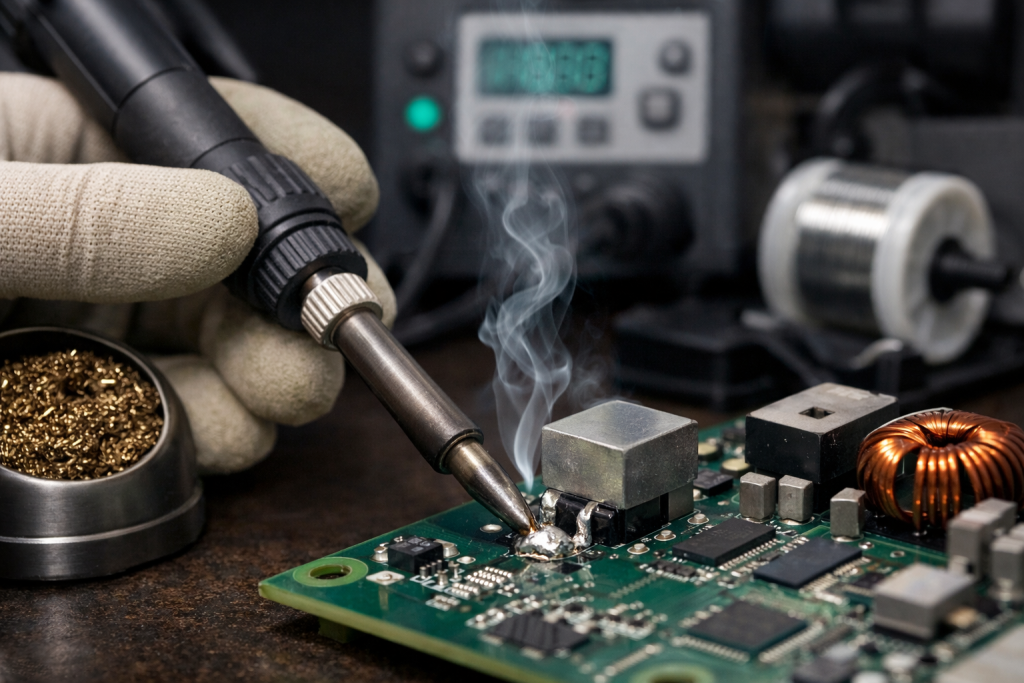
In the world of high-precision electronics manufacturing, mass soldering processes like convection oven reflow, vapor phase, and wave soldering are the undisputed champions of volume and efficiency. However, the “one-size-fits-all” approach of a reflow oven often hits a physical wall when confronted with a common engineering hurdle: disproportionate thermal mass.
When a PCB design requires a few components with significantly larger thermal mass than the surrounding surface-mount devices (SMDs), a standard reflow profile may be insufficient. If you calibrate the oven for the heavy components, you risk frying the delicate sensors; if you calibrate for the delicate parts, the heavy components suffer from “cold” joints. In these specialized scenarios, hand soldering isn’t just an alternative—it is a critical, controlled process necessary to ensure long-term reliability.
The Physics of the Perfect Joint
Hand soldering is often underestimated as a simple manual task. In reality, it is a complex heat-transfer equation. To achieve a reliable solder joint on a large-mass component, four critical process elements must be synchronized:
1. Heat Source Selection: Reservoir vs. Constant Temperature
Not all soldering irons are created equal. For high-precision industrial work, the choice of heat source dictates whether you can maintain the thermal “headroom” necessary for heavy parts.
-
Reservoir Soldering Irons:
These store energy in a large thermal mass within the iron itself. While traditional, they often struggle with “recovery time.” After one joint, the tip temperature drops significantly, leading to inconsistent results during repeated use.
-
Constant Tip Temperature Irons:
Modern precision manufacturing favors irons with active temperature monitoring. These use sensors to detect heat loss the moment the tip touches the component, instantly pumping more energy into the tip to maintain a selected constant temperature. This is vital for large components that act as heat sinks.
2. The Geometry of Heat Transfer: Tip Selection
Think of the soldering tip as a gate. If the gate is too narrow, heat cannot flow fast enough to overcome the thermal mass of the component.
-
Maximize Contact:
The goal is to maximize the physical surface area where the tip meets the material. A larger contact area equals more efficient heat transfer.
-
Minimize Loss:
A tip that is improperly shaped for the joint promotes heat loss to the surrounding air rather than the joint itself. Conversely, an undersized tip extends “dwell time,” which can lead to board delamination or tip deterioration.
3. Flux: The Chemical Catalyst
Flux is more than just a cleaning agent; it is a heat-transfer medium. In hand soldering, flux is typically delivered via a “core” within the solder wire.
-
Type Selection:
Whether using No-Clean, RMA (Rosin Mildly Activated), or OA (Organic Acid), the choice depends on your post-solder cleaning capabilities.
-
The Amount Matters:
The flux must be sufficient to remove oxides and facilitate the “wetting” of the metal. If the flux channel in your core solder is too small, the heat transfer will be inhibited by remaining surface contaminants, resulting in a brittle, unreliable connection.
4. The Critical Element: Time and Technique
In mass soldering, time is a machine setting. In hand soldering, time is operator-dependent, making it the highest variable risk.
For large-mass components, the most common failure is “Transfer Soldering.” This occurs when an operator melts the solder against the iron tip and allows the liquid solder to “drip” onto the cold component. This creates a weak intermetallic bond—a “cold joint”—that looks attached but will likely fail under vibration or thermal cycling.
The Professional Technique: To ensure the component has reached the proper temperature, place the iron tip on the component/pad surface first. Then, touch the core solder to the component surfaces, not the iron tip. When the solder melts against the component, you have visual confirmation that the target material has reached the required temperature.
Why Coordination is Key
Navigating these technical requirements—AS9100 standards, thermal profiling, and specialized hand-soldering techniques—requires a partner who understands the intersection of engineering and manufacturing.
While many providers offer basic assembly, high-precision sectors like semiconductor fabrication and aerospace require a deeper level of technical integration. Coordinating your project with a specialized partner ensures that these manual steps are not “afterthoughts” but are integrated into a holistic Quality Management System. By communicating directly with the engineering team at Smartlink Engineering, you ensure that your high-thermal-mass challenges are met with the right technology and documented precision.
Frequently Asked Questions (FAQ)
Q: Why can’t I just run my large components through the reflow oven with everything else? A: Large components act as heat sinks. To get them to soldering temperature, you might have to extend the “soak” time or increase the peak temperature of your oven. This can exceed the thermal limits of smaller, sensitive components on the same board, leading to heat damage or “popcorning” of IC packages.
Q: Is “No-Clean” flux always the best option for hand soldering? A: It depends on the environment. While No-Clean saves a process step, for high-reliability aerospace or medical applications, even minimal residues can be a concern. A specialized partner can help you determine the best flux-to-cleaning ratio for your specific industry standards.
Q: How do I know if my soldering iron is “Constant Temperature” or “Reservoir” type? A: Most modern industrial stations (like those used in Shah Alam or Penang facilities) are constant-temperature units with digital readouts and fast-recovery heating elements. Reservoir irons are typically older, “plug-and-play” sticks without a base control unit.
Q: What is the biggest sign of a failed hand-solder joint on a large component? A: A “balling” effect where the solder sits on top of the pad rather than “wetting” or flowing out into a smooth fillet. This usually indicates that the component was too cold when the solder was applied (Transfer Soldering).
Q: How can I ensure my project meets AS9100 or high-precision standards? A: The best way to guarantee compliance is through early-stage coordination. Discussing your PCB layout and component mass with the experts at Smartlink Engineering allows for the development of a specific manual soldering SOP (Standard Operating Procedure) for your project’s unique needs.